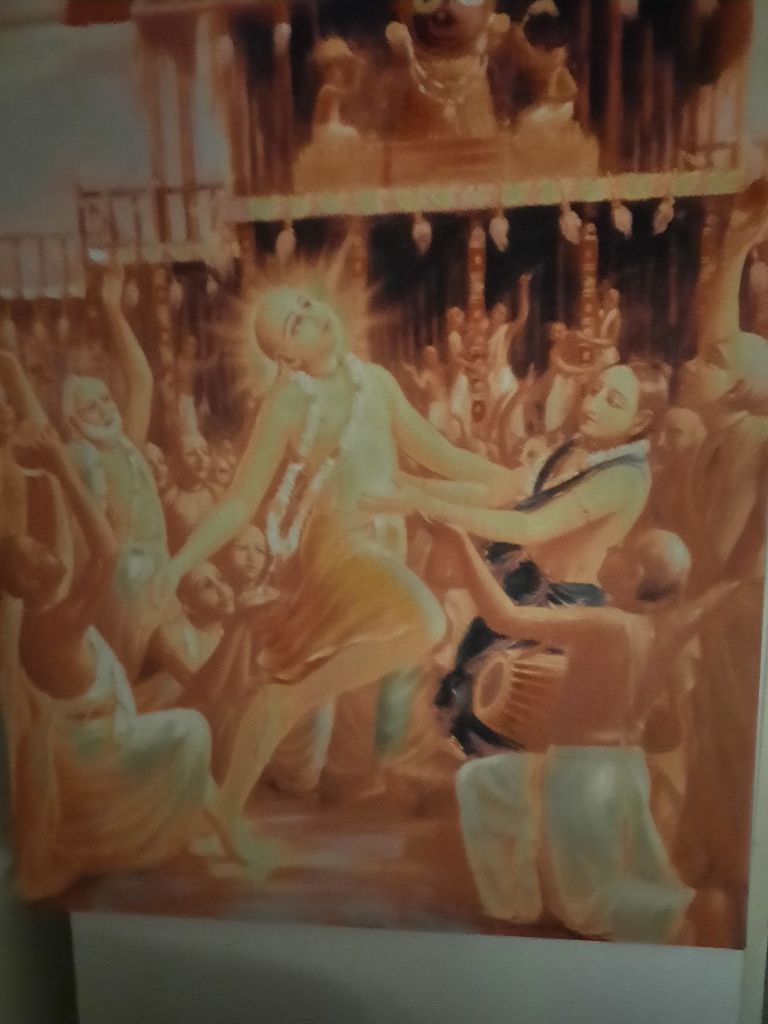
Caitanya Caratamrita Ādi 1.5
রাধা কৃষ্ণপ্রণয়বিকৃতির্হ্লাদিনীশক্তিরস্মা–
দেকাত্মানাবপি ভুবি পুরা দেহভেদং গতৌ তৌ ।
চৈতন্যাখ্যং প্রকটমধুনা তদ্দ্বয়ং চৈক্যমাপ্তং
রাধাভাবদ্যুতিসুবলিতং নৌমি কৃষ্ণস্বরূপম্ ॥ ৫ ॥
rādhā kṛṣṇa-praṇaya-vikṛtir hlādinī śaktir asmād
ekātmānāv api bhuvi purā deha-bhedaṁ gatau tau
caitanyākhyaṁ prakaṭam adhunā tad-dvayaṁ caikyam āptaṁ
rādhā-bhāva-dyuti-suvalitaṁ naumi kṛṣṇa-svarūpam
Synonyms
rādhā — Śrīmatī Rādhārāṇī; kṛṣṇa — of Lord Kṛṣṇa; praṇaya — of love; vikṛtiḥ — the transformation; hlādinī śaktiḥ — pleasure potency; asmāt — from this; eka–ātmānau — both the same in identity; api — although; bhuvi — on earth; purā — formerly; deha–bhedam — separate forms; gatau — obtained; tau — those two; caitanya–ākhyam — known as Śrī Caitanya; prakaṭam — manifest; adhunā — now; tat–dvayam — the two of Them; ca — and; aikyam — unity; āptam — obtained; rādhā — of Śrīmatī Rādhārāṇī; bhāva — mood; dyuti — the luster; su–valitam — who is adorned with; naumi — I offer my obeisances; kṛṣṇa–svarūpam — to Him who is identical with Śrī Kṛṣṇa.
Translation
The loving affairs of Śrī Rādhā and Kṛṣṇa are transcendental manifestations of the Lord’s internal pleasure-giving potency. Although Rādhā and Kṛṣṇa are one in Their identity, previously They separated Themselves. Now these two transcendental identities have again united, in the form of Śrī Kṛṣṇa Caitanya. I bow down to Him, who has manifested Himself with the sentiment and complexion of Śrīmatī Rādhārāṇī although He is Kṛṣṇa Himself.
Krishna is one but has become many , He possesses innumerable potencies and Saktis or energies such as the spiritual, material, and marginal potencies .
The trancendental mysteries of the absolute truth of Simultaneously and inconceivably one and difference between the Supreme Personality of Godhead and his expansions have been elaborately written on by the Gaudia Vaisnava acaryas , the Caitanya Caratamrita by Krishna das Kaviraja brings us the conclusions of the direct disciples of Sri Caitanya Mahāprabhu, known as the Goswami’s of Vrndavana headed by Rupa and Ragganatha das Goswami’s.
The verse above highlights these truths , but also the fact that even Lord Krishna cannot understand Srimati Radharani’s love and attraction for Himself, or the happiness She feels in His company . If we were to accentuate the oneness of God to all living beings, then why is it Krishna Himself can not understand the depths and attractions of Radharani’s love ? Although on the absolute tattva platform, as the verse above shows, Radha and Krishna were one , but what is indicated is that for pleasure and to increase rasa and the pleasures, they became two . Indeed Krishna also expands as Balarama and the expansions of all the individual jivas , who are eternally situated in oneness and difference takes place . Everything and everyone are eternal because “it and they” come from the eternal, thus Srila Jiva Goswami says in his tattva Sandarbha that Krishna makes the impossible possible.
The Gaudia Vaisnavism siddhanta of simultaneous oneness and difference is the final conclusion in philosophical positioning from Sankaracarya, Madhava Acarya , Ramanujacarya , Nimbarka Acarya to Sri Caitanya Mahāprabhu who discussed and systematically brings us the final trancendental doctrine.
This philosophical progression described traces the historic Vedāntic discourse culminating in Acintya-bhedābheda (inconceivable simultaneous oneness and difference), propounded by Sri Caitanya Mahāprabhu.
Within the Gaudiya Vaiṣṇava tradition, this doctrine is understood as a synthesis that resolves the apparent contradictions between earlier Vedāntic schools while preserving the personalist devotion (bhakti) central to the Bhāgavata Purāṇa.
http://www.thevedicspectator.com