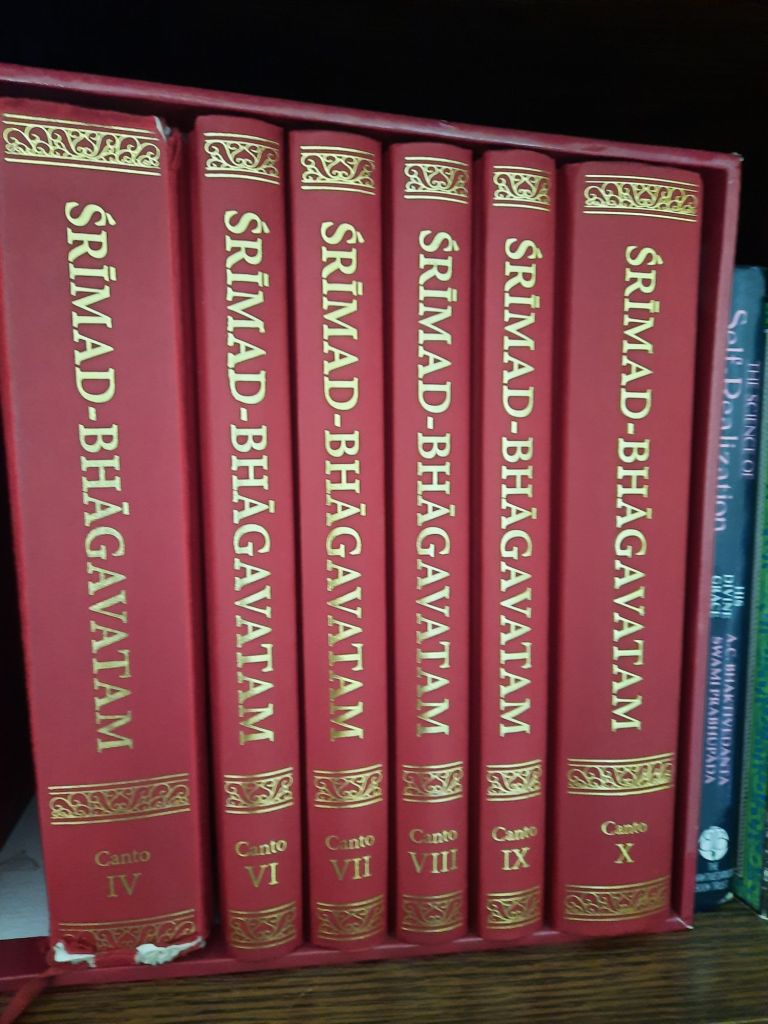
Why should I have any interest in an ancient scripture called the Srimad Bhagavatam? Most people will ask , what does it contain anyway? what is in it for me, or what benefits can it offer society as a whole? How can such ancient literature possibly have any relevance in today’s technological world with fast communication and instant pleasures for the body , mind, and senses. Modern globalists say that economic development is liberating the world from poverty and bringing new improved lives far better than life used to be, and we don’t want to go back in time .
These kind of questions many people will naturally ask when approached by those who study the science of self-realization contained within the Bhagavatam . The Bhagavatam contains numerous topics within its 18000 verses , sciences of many kinds , including time relativity and cosmic karmic synchronicities, sociology , socio-political governance and compliance systems , as well as the responsive universe and its atomic and ethereal implications on the free will , determinism and justice is written on , and much much more . The study of consciousness within the confines of matter is an essential topic , and scientific materialism, as well as the Darwinian hypothesis, puts a stop to these natural mysteries that many persons of this age refuse to confront . We are individual living beings with consciousness , every living being has consciousness , each of us find ourselves within spacetime in a particular dimension on a particular planet , along with the body that is under “mother natures ” strict physical laws that everyone is forced to submit to.
The progressive spiritual seeker appreciates that the contents of the Srimad Bhagavatam and sees clearly it does not contradict any of the objective sciences that can be referenced .Although scientific materialism and the Darwinian hypothesis are rejected outright. Today, multidimensional spacetime is readily accepted by modern physicists, the Harvard PROFFESOR Lisa Randall teaches openly such mathematical proven observations . Biologists see the significance and obvious signs of design and mathematical symmetry in the organic world they study . Leading chemists are aware that a theory that consciousness is an upshot of a combination of material chemicals randomly conjoining is becoming increasingly silly to repeat .It is ultimately a lame attempt by the Darwinians to explain incomprehensible complexities’ in subjective limited ways ,and it’s fooling no one these days , except for die hard Darwinians, who can’t think for themselves.
The substrata of the material universe is fundamentally atomic; so says the Srimad Bhagavatam. Coincidentally, Niels Bohr, who helped define the Copenhagen interpretation of quantum physics, also studied the Vedas closely. The Bhagavatam describes material nature as a quantum reality driven by an ethereal mind with endless possibilities .Karmic synchronicities are at play in the responsive ethereal and atomic universe, this reality which responds to the free will and determinism of each individual within it , is described in the third and fifth Canto of the Srimad Bhagavatam. The Srimad Bhagavatam also elaborates fully on multidimensional spacetime and the living beings who are differently subjected . The Bhagavatam introduces the concept of three overarching principles, or modes of material nature , these are subtle conditioning that effect the mental and intellectual aspects of our lives , bringing lifestyles. Many scientific discoveries are made , but modern life is incomprehensible to the greatest of physicists. They are puzzled that gravity on earth is a relatively weak force but yet pulls the whole of the oceans , a magnet easily overcomes gravity. The Bhagavatam’s resolution for the puzzled (in keeping with Kantian logic that senses do not perceive all levels of existence) is acceptance of the ethereal plane . This ethereal plane , as yet undetected by sciences, has an existence that defines and is immediately linked to the current laws of quantum and classical physics. This is free will and determinism at play on multiple platforms.
What is the origin of the Srimad Bhagavatam?
The Srimad Bhagavatam is a natural commentary on the Vedanta Sutras. ‘Veda’ means ‘knowledge’, and ‘anta’ means ‘ultimate’. The Vedanta sutra comprises of condensed forms of information .They are sort of codes or stanzas that can be greatly expanded upon by the pure representatives of them .The Vedanta sutra itself is a distillation of the original knowledge from the four Vedas written by the sage Vyasadeva. These voluminous original four Vedas give directions to mankind for all kinds of developments and progress in every conceivable way that is needed for mankind. At the same time, they underline the main purpose of human life is to link to God and learn to love God.
All living beings already have a connection with God , He is situated within all beings. Inspiration, for example, is a phenomenon that clearly exists. Researchers, philosophers, and scientists often comment that ‘eureka’ moments confront them at the unlikeliest of moments. Shopping for food or perhaps feeding the pet dog . The physicist Richard Feynman has commented that an intense focus of attention to a sticky problem predictably leads to an extraordinary emergeance of solutions. Similar experiences are shared by many in an unusual manner during creative and artistic moments.
The achievements of writers and philosophers should not be overlooked but rather judged by their merits. Vyasadeva compiled the Vedas many thousands of years ago, and these are inspired works by any estimation. As a literary incarnation of God himself, He is the source of all inspiration . If one examines Vyasadeva’s works, one will discover on inspection, he has some very pertinent things to say about every aspect of life.
The Srimad Bhagavatam presented to you by the scholar and devotional practitioner Srila A.C. Bhaktivedanta Swami Prabhupada is a commentary on the original four Vedas along with their summary , the Vedanta Sutra. It incorporates the teachings of four original professors of spiritual knowledge, namely Lord Brahma, Sri Laxmi , the Kumara sages, and Lord Shiva. These professors of knowledge established lineages, known as ‘sampradayas’, they protect and pass down the Vedic knowledge from one generation to another. Scholars of prominence of these four ‘sampradayas’ are Madhvacarya, Ramanujacarya, Nimbarkacarya, and Vallabhacarya. Their teachings are incorporated into Srila AC Bhaktivedanta Swami Prabhupada’s purports within the Srimad Bhagavatam texts. Prabhupada was himself taught by his own teacher, or spiritual master, Srila Bhaktisiddanta Sarasvati Goswami , who was the son of Srila Bhaktivinod Thakur , Srila Bhaktisiddhanta Sarasvati Goswami was a disciple of Srila Gour Kisor das babaji .
Historically , and according to time and circumstance, the above historical scholars of the Indian sub-continent presented the full picture of the Absolute Truth systematically . The full picture of the individual living being and God is presented. They are inconceivably one and different from one another. Each of the eminent scholars brings to the fore similar conclusion, but in slightly different ways. They all inform us of the big picture. An appreciation of the ‘advaita-vada’, or ‘oneness’, of one scholar, should be balanced with an appreciation of the ‘dvaita-vada’ or ‘difference’ from God, of another scholar .
A.C. Bhaktivedanta Swami is a follower of the teachings of Sri Caitanya Mahaprabhu, who is Krishna Himself , and He is the most recent exponent of the teachings of the Srimad Bhagavatam along with the explicit truth of the inconceivable oneness and difference of each living being with God .Sri Chaitanya Mahaprabhu entrusted His teachings to His direct disciples Sanatana Goswami, Rupa Goswami, Jiva Goswami and Raghunatha das Goswami, who in turn established His teachings on a sound scriptural and philosophical basis. Today, the erudition of these Goswamis is greatly respected in universities throughout the world.
Sri Caitanya Mahaprabhu’s ultimate teachings is that all living beings have an eternal relationship with the Supreme Personality of Godhead , Sri Krishna , in one of five ‘rasas’ or varieties of loving mellows . From neutrality through to divine conjugal love. These relationships are described in the Vedas as confidential, more confidential, and most confidential.
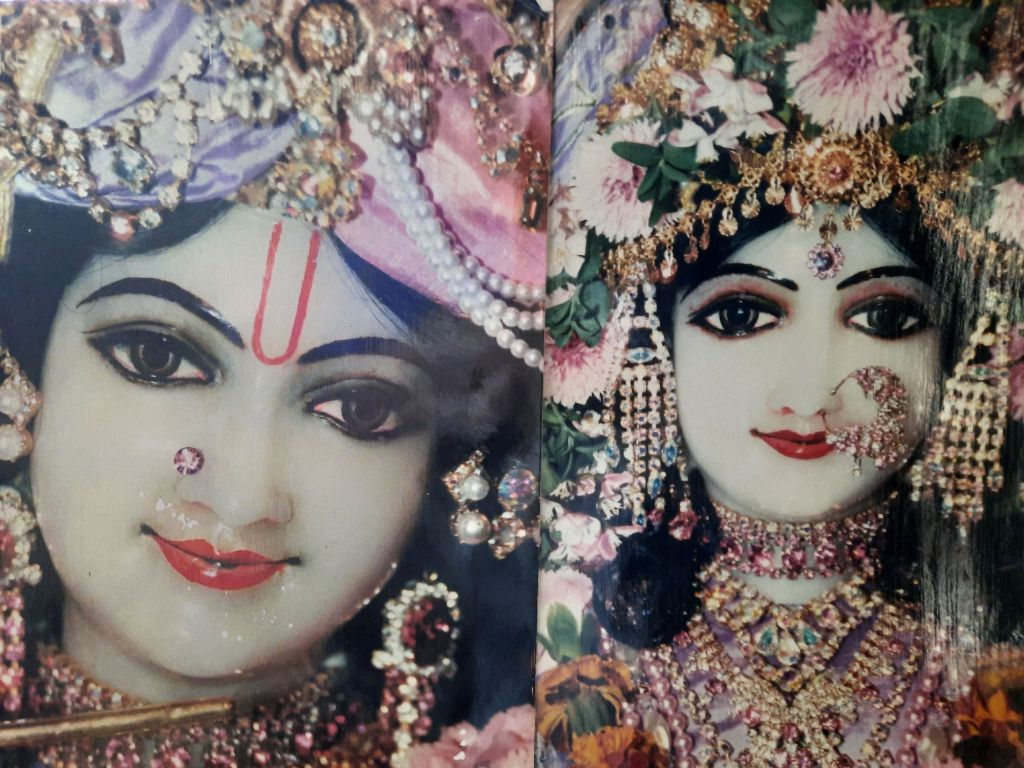
A.C. Bhaktivedanta Swami explains in his introduction to the Bhagavatam that the broad conception of ‘God’ is not on the same level as a realisation of the Absolute Truth , The Supreme Personality of Godhead Sri Krishna. The Srimad Bhagavatam brings into focus the Absolute Truth , the Supreme Personality of Godhead Sri Krishna , who Himself possesses innumerable energies which are manifested in the perfect design and perfect order we witness around us . Krishna is the cause of all causes , who is acting through his many expansions to facilitate the free will of the individual being in this world . Krishna also fashions nature in such a way as to guide and correct living entities so that they are given opportunities to restore themselves to their constitutional position of spontaneous love of God .
The principles of the Bhagavatam can be applied in all fields , political, social, economic, judicial, military, sociological etc etc , and they’re principles that can raise the merit of any value system. There is much that can be gleaned in the Bhagavatam for the spiritual upliftment of all living beings . The spiritual perfection of love for Krishna encompasses and includes love for every living thing since all living things are eternally parts and parcels of Him. The symptoms of someone completely on the spiritual platform are the absence of all anxieties and satisfaction along with bliss . There is no personal concern for material loss , nor hankering for material temporary gains whatsoever. This state is termed the “param gatim”, the supreme goal of life superseding all other goals, and quite naturally the goal which should always be born in mind.
Surrender without reservations to the representative of truth



When Arjuna was on the battlefield of Kuruksetra , a war that was fought on many fronts , Sadaputa prabhu , one of the original members of the Bhaktivedanta institute , mentioned there were millions of soldiers within a limited area , so it appeared to be a kind of universal war involving many demigods and demons from other regions . Anyhow , the beginnings of the Bhagavad Gita tell how Arjuna initially was not prepared to fight. The early parts of the Bhagavad Gita explore his arguments , so one can carefully read of why he did not want to fight and for seemingly good reasons , and importantly one can read how Krishna instructed Arjuna on all of his concerns.
Arjuna became bewildered because he had to, and rightly so , consider every type of moral and ethical behaviours as well as Vedic Sattvic Dharma , as a good warrior does . A good soldier is not a cold, ruthless killer . Certainly, soldiers are absolutely forbidden to kill women and children or any citizens , which is condemned by universal laws and reactions will be had long into the futures. Legitimate warfare is a tricky business to contemplate and enact, and many considerations should be made . Arjuna turned to Krishna , the Supreme Personality of Godhead, and submitted himself to Him because Arjuna was confused. He asked Krishna what he should do in the circumstances and what would be the right course of action for him . Arjuna , importantly, and obviously had initial faith that Krishna would give him good advice . Authorities must have a proven source of knowledge. The sentiments and mental energies of an individual are no authority.
At the point where Arjuna turned to Krishna and submitted himself in honesty and with humility, Krishna took up the position as Arjuna’s spiritual Guru . He thus chastised Arjuna calling him Mudha , a fool , for thinking he was speaking learned words in his giving the reasons why he had not been prepared to fight . Krishna began to point out Arjuna’s lack of real knowledge both materially , in his Dharmic considerations , and spiritually in terms of what the consciousness is , ie an eternal energy completely seperate from matter in all its forms . Krishna related to Arjuna what the ultimate duty is for mankind and also what the ultimate morality was . Krishna was taking both spiritual and material duties into consideration. Spiritual consciousness and its balanced development are always a priority for everyone , and , of course, that is what Krishna teaches within the Bhagavad Gita . Arjuna was only initially calculating things that were to satisfy his own limited interests. The Bhagavad Gita is an essential read for all persons. It is the practical life manual and suits all people in all walks of life. Nothing is absent. Everyone is differently situated materially and spiritually, but the Bhagavad Gita situates everyone.
The important point here is that Arjuna initially turns to Krishna with faith and is prepared to hear from Krishna .Everyone has faith in something, but Krishna has been confirmed throughout universal history in all the Vedas as the original cause of all cause of both the material and spiritual dimensions , and essentially He has been accepted by the greatest of authorities . We must know the authentic teachers and reject those who speculate or accept others who speculate as their teachers .
After hearing from Krishna, Arjuna’s doubts were cleared , and all his misconceptions vanished . Bhagavad Gita makes everything clear to everyone. Arjuna intelligently surrendered WITHOUT RESERVATIONS , and he spoke as follows
Arjuna said: You are the Supreme Personality of Godhead, the ultimate abode, the purest, the Absolute Truth. You are the eternal, transcendental, original person, the unborn, the greatest. All the great sages such as Nārada, Asita, Devala and Vyāsa confirm this truth about You, and now You Yourself are declaring it to me.
This full surrender without reservations is required when it comes to taking Sri Guru , who is the true representative of Krishna’s, and who comes in many forms , both as Diksa and Siksa gurus . Sadhu Sastra and Guru are the three balanced principles., one checks the other .Whether Diksa or Sisksa , and in particular the highest sense of Siksa , of the higher Madhyama or Uttama , should not be doubted , but what he says the whole chain of param para Gurus must say . He can be questioned, but we must be prepared to accept his answers , as Arjuna accepted Krishna’s answers.
It might take time to understand Sri Guru, but we must be patient , and Krishna will help us . A bone fide Guru as Krishna was to Arjuna , explains everything logically with reference to authority , such a Uttama Guru or high Madhyama can be and should be surrendered to without reservation.
http://www.thevedicspectator.com
Sep 13, 2026
http://www.thevedicspectator.com