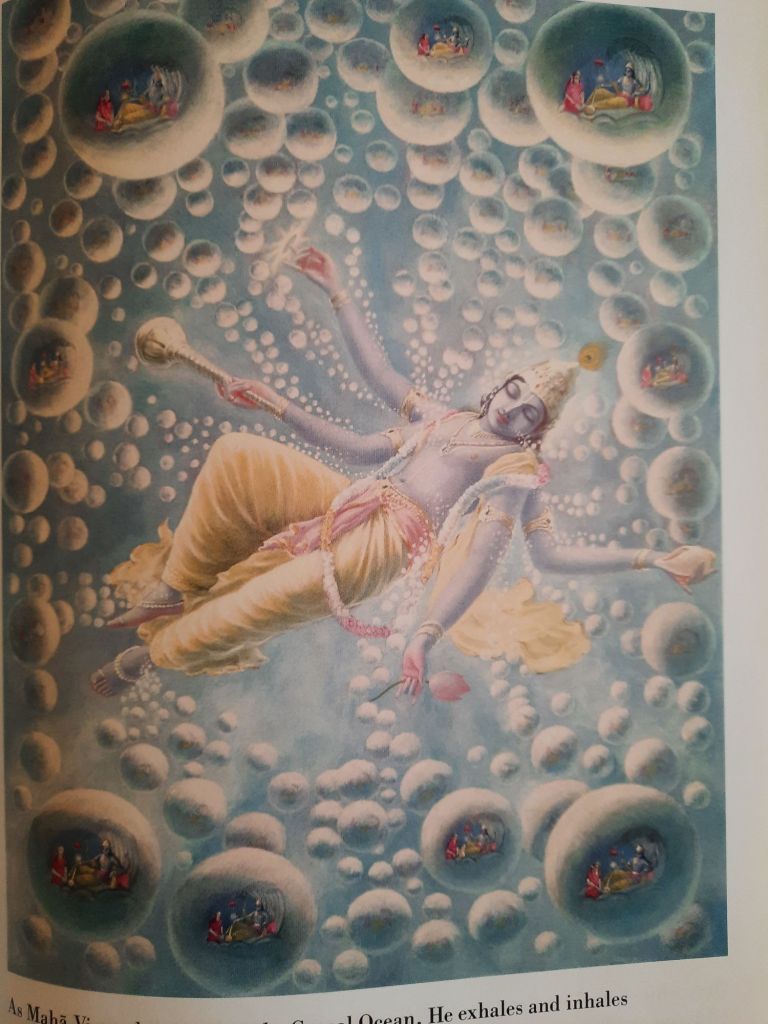
The Vedic Spectator examins and writes on the psychological effects of the modes of subtle nature as discussed in Bhagavad Gita , it examines the fields of quantum physics and its parallels to the ethereal and atomic realms within the Vedas . Niels Bohr and Schrödinger both studied the Vedas , and their studies and the conclusions of the Copenhagen agreement suggest reality is not merely a plane of classical physics but there are realms of quantum uncertainty . The Vedas define an individual consciousness and the many possibilities driven by free will , uncertainty , and everything contained and confined within a responsive universe . A conscious universe is spoken of , the universal form , that quantum physics just may have revealed to all , it tells us the universe knows what one part of it is doing , although it is billions of miles apart .
The intersection of Vedantic philosophy and quantum mechanics highlights profound conceptual parallels regarding observation, interconnectedness, and the nature of reality. While pioneers like Erwin Schrödinger and Niels Bohr engaged with and drew inspiration from ancient vedic texts, mainstream scientific thinkers find it all too difficult to accept being overly influenced by scientific materialism . Such conceptual mirrors have the atheistic shaking in their boots , after all, perfect mathematical foundations and symmetry are the very foundation of quantum theory as well as the universe around us .
Parallels Between the Vedas and Quantum Theory. The Observer Effect: The Bhagavad Gita and Upanishads position consciousness as primary , where the observer and the observed are fundamentally non-dual . The conclusion of the Bhagavad Gita is rather we are one and different . Spiritual dualism is taught . Early discussions in quantum mechanics where the act of measurement or observation plays a critical role in determination of outcomes , suggest the consciousness can and does manipulate matter past , present and future collide in the Vedic sciences, as Einstein taught , space time continuum . The observer should also be taken as an actor , says the Vedas . Entanglement and Non-Locality: The concept of universal interconnectedness (Tat Tvam Asi) aligns metaphorically with quantum entanglement, where particles separated by vast distances instantaneously mirror or relate to one another’s states. The supersoul, an expansion of Krishna and the greater universal form is fully conscious of every living being as well as every atom and where it should be allocated. The Illusion of Separation: The Vedantic concept of Maya (the illusion of distinct, fragmented material division) parallels the subatomic realization that solid matter dissolves into fluid probabilities and unified wave-like fields , and that the individual free will and determinism drives the responsive arrangements, supervised automatically by Divine algorithmic processes . Historical Nuances in Physics and Philosophy Schrödinger’s Non-Dualism: Erwin Schrödinger explicitly credited the Upanishads for shaping his philosophical views on identity and consciousness, writing that his understanding of the singular “I” directing the body mirrored Vedantic non-dualism (Advaita Vedanta). Schrödinger had an emphasis on oneness of everything , but however the ultimate Vedic conclusion is that everything and everyone is simultaneously one and different from each other and God . Bohr’s Complementarity: Niels Bohr noted that his principle of complementarity—the idea that light or matter , matter is ultimately made up of electrical charges akin to light , can exhibit mutually exclusive properties like wave-like or particle-like behavior depending on who is wanting what .—i.e free will and determinism in the responsive universe.
In reality scientific materialism and Darwinian hypothesis are a dying breed , the Bhaktivedanta institute and the discovery institute will in time revolutionise the sciences, no more guessing and subjective opinions , but rather objectively seen sciences and the world of self evident dualism will arise . That will also effect economics and politics , if you know what you are you know what you need and don’t need . Self-evident truth and respect for everyone and every culture will result
http://www.thevedicspectator.com