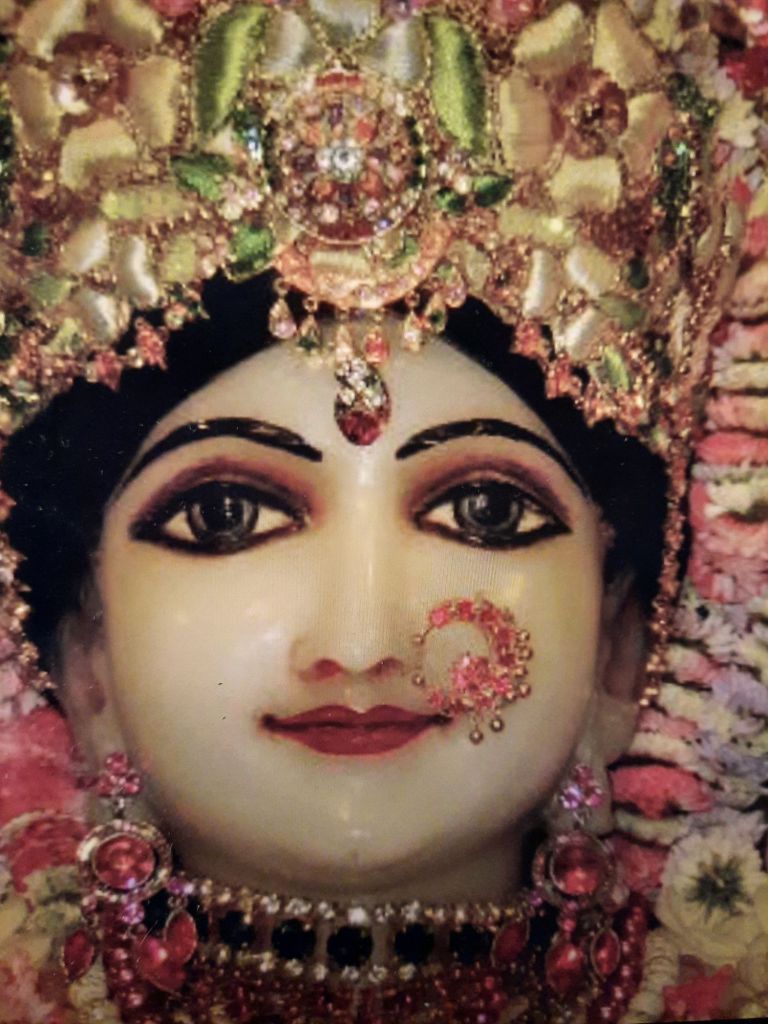
Apart from the conversation with Ramananda Roy ,where Sri Caitanya Mahāprabhu gets Ramananda Roy to reveal the Glories of Srimati Radharani , and in the last verse of Śikṣāṣṭaka, where Mahāprabhu indirectly Glorifies Her , are there any other examples of Caitanya Mahāprabhu personally glorifying Srimati Radharani…
Something that came to me ..and the reason why the Hare Krsna maha-mantra is not directly mentioned in the Caitanya Caratamrita .
Srila Rupa Goswami and our acaryas have taken that ancient Maha mantra , and via Sri Caitanya Mahāprabhu have enthused the names with Radha Krishna nitya lila .and Madurya rasa as well as Parakiya and the other Rasas of Sri Vrndavana Dharma. The maha-mantra means Radha Krishna, both Radharani and Krishna are prayed to and served , Mahāprabhu in the mood of Radharani would chant Hari and other names of the Lord .
Why is Sri Caitanya Mahāprabhu not directly glorifying Srimati Radharani? because He is predominantly in the mood of Radharani, and it would be like Srimati Radharani glorifying Herself…Something She would never do …
Ai pulls up these examples from Sastra.
Apart from the famous conversation with Ramananda Roy and the 8th verse of the Śikṣāṣṭaka, Caitanya Mahāprabhu does personally glorify Śrīmatī Rādhārāṇī in several other places. Since Caitanya Mahāprabhu is Kṛṣṇa in the mood of Rādhā, most of His direct glorification comes out when He’s in bhāva as Rādhā Herself.
Here are the key examples:
1. In His prayers and lamentations at Gambhīrā, Jagannātha Purī
Caitanya Mahāprabhu spent 18 years in seclusion at the Gambhīrā. Biographers like Murāri Gupta, Svarūpa Dāmodara, and Kṛṣṇadāsa Kavirāja record that He would constantly pray in Rādhā’s mood.
- “Rādhā-kṛṣṇa-praṇaya-vikṛtir…” — the opening verse of Caitanya-caritāmṛta. Though written by Kṛṣṇadāsa Kavirāja, it states this is Mahāprabhu’s own understanding: He appeared to taste the sweetness of Rādhā’s love and to glorify Her greatness. So His whole incarnation is framed as glorification of Rādhā.
- Verses in Caitanya-caritāmṛta Madhya 14 & 15: When Mahāprabhu hears kīrtan of Rādhā-Kṛṣṇa pastimes, He breaks into states describing Rādhā’s unique love. E.g. He says Rādhā’s prema is the highest, that Kṛṣṇa Himself cannot understand it without becoming Rādhā. This is direct glorification of Her mahābhāva.
2. In conversation with Svarūpa Dāmodara and Rāmānanda Rāya
Beyond the initial Rāya Rāmānanda dialogue, Mahāprabhu repeatedly asked them to sing verses glorifying Rādhā’s prema. He would weep and say no one can understand Rādhā except Kṛṣṇa Himself, and Kṛṣṇa can’t understand Her without taking Her position — which is why He came as Caitanya.
3. In the Śikṣāṣṭaka context
While verse 8 is indirect, the entire Śikṣāṣṭaka is spoken in the mood of Rādhā in separation. Verse 7: “yugāyitaṁ nimeṣeṇa…” is Rādhā’s feeling of separation from Kṛṣṇa. So the whole set is Mahāprabhu glorifying Rādhā by embodying Her mood.
4. In the Kṛṣṇa-karṇāmṛta and other songs He relished
Mahāprabhu had Svarūpa Dāmodara read to Him texts like Kṛṣṇa-karṇāmṛta by Bilvamaṅgala, which are saturated with Rādhā’s glories. He would go into ecstasy and explain how those verses reveal Rādhā’s superiority in mādhurya-rasa.
Core point in Gaudiya theology:
Caitanya Mahāprabhu rarely glorifies Rādhā using His “Kṛṣṇa” identity, because He came as Rādhā-Kṛṣṇa combined. His glorification of Rādhā is most fully expressed by becoming Her and tasting Her mood. That’s why Rāmānanda Rāya had to draw it out of Him — Mahāprabhu in Kṛṣṇa’s form is reticent, but in Rādhā’s mood He overflows with Her glories.
It appears that in Glorifying, Krishna, in the mood of Radharani, Mahāprabhu is also , of course, even more so , i Glorifying Srimati Radharani .
Mahāprabhu has come to pay back the overwhelming love of Srimati Radharani, and her mood reveals Her glory.
http://www.thevedicspectator.com