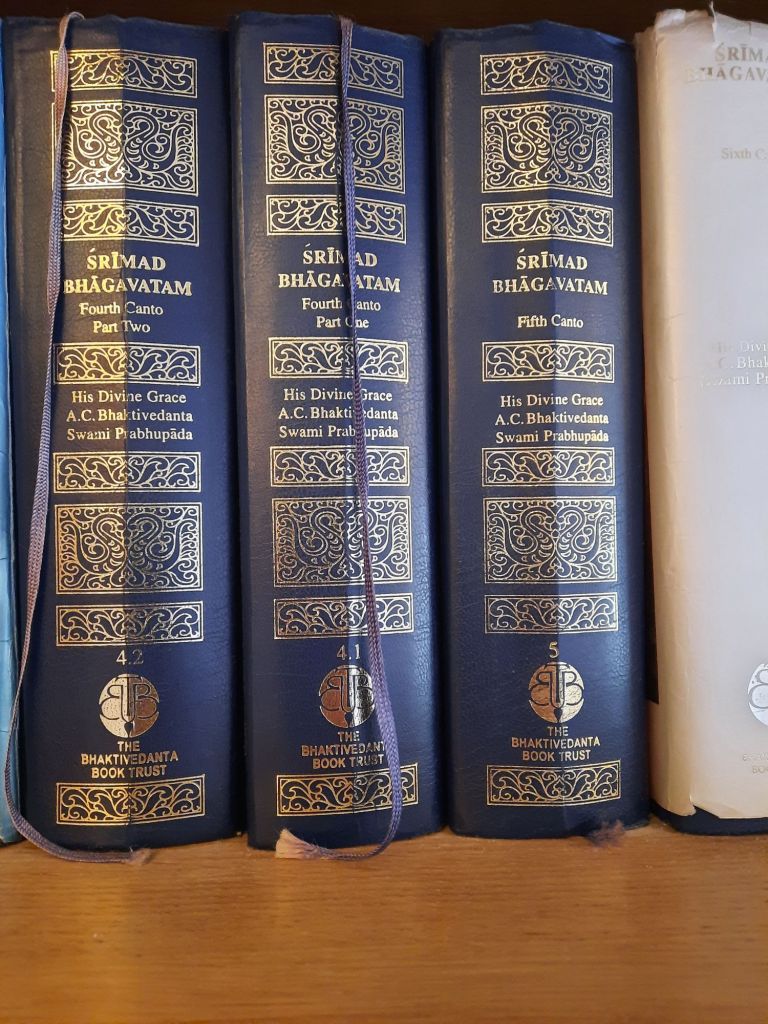
If you want to understand something of Krishna along with His supreme dominion and Lordship over everything and everyone , simply read Bhagavad Gita as it is .
No one could have spoken like this apart from the Personality who originated and engineered everything, the concepts and truths which are all objectifiable , are still incomprehensible in todays modern scientific world, where any observations be in in the microbial world or in universal affairs reveals more and more perfect math ,symmetry ,and obvious design , as one would expect, if Krishna’s Bhagavad Gita is taken as truth .
http://www.thevedicspectator.com
The teachings of the Bhagavad Gita, the conversation between Krishna and Arjuna, cover five primary subjects .
- Ishvara (The Supreme Lord/Controller): The Gita establishes the existence of a supreme Personality of Godhead who is directly and indirectly conscious of everything and everyone .Lord Krishna is God, who is the creator and controller of all things.
- Jiva (The Living Entity/Soul): This refers to the individual spirit soul, who is simultaneously one and different from Divinity, the jiva is distinct from the material body it inhabits , he is spiritual like Krishna.
- Prakriti (Material Nature): The material world and nature, which is temporary and acts under the direction of the Supreme Lord. The material energy is one of God’s direct energies and thus not different than Him .The scientific community understand matter is never destroyed but is transformed, indeed this is so matter is the eternal energies of God , but an inferia one
- Kala (Eternal Time): Time is explained as an indestructible, eternal force that influences and controls the material creation. Space time as Einstein mentioned is combined and relative, time begins when the particles of consciousness enter matter and then the universe expansion begins. Space time continuum means the past , present, and future are interlined by karmic synchronicities that interact and respond to each other in a responsive universe.
- Karma (Activities/Action): The law of action and reaction, highlighting that every action has consequences that bind the soul to material life, but can be performed in a way that leads to liberation. Prarabdha karma and aprarabdha karma immediate effects and later effects, the universal responsive universe along with divine algorithms beyond the comprehension of the greatest of scientists are at play .
Themes of the Bhagavad Gita .
- Dharma: Fulfilling one’s duty, whatever that might be , the vedas teach everyone the benefits of duties spiritual and material that lead to social and spiritual mobility when the two duties are combined.
- Yoga: Various paths to connect with the divine, including Karma Yoga , Niskama karma , jnana yoga and Bhakti Yoga (devotion), Bhakti should be applied to all types of yoga , that leads to pure Bhakti and spontaneous love of God in an esoteric spiritual original realm
- Atman: The nature of the true self and its immortality and its position as a part and parcel of God and a service to God is the eternal occupation of the soul .
- Moksha: Liberation from the cycle of birth and death, three types of liberation which culminate in directly associating with Sri Sri Radha Krishna in the spiritual kingdom of Vrndavana.
- Detachment: Focusing on duty rather than the rewards of actions , becoming the servant of the servant, and giving all pleasure to the emaculate senses of Krishna, who is the supreme autocrat.
- http://www.thevedicspectator.com