The Bhagavatam seeks to recognize the absolute importance of persons who have sufficient knowledge to not only properly guide society on an individual basis and collectively , according to the specific and most essential needs of an individual , or a community or indeed , an individual Nation . The Bhagavatam demonstrates and makes clear what this type of knowledge is composed of , it points out clearly what the real needs of everyone actually are , based on the living beings real position , those observations are made based on various scientific conclusions , verified by todays biologists , Chemists and Physicists who are dedicated to objective scientific conclusions . The Srimad Bhagavatam always demonstrates a fully comprehensive approach to life, which is non sectarian and is open to all . It also makes it clear how this essential knowledge is obtained and how it is practically applied in the myriad of communities of humankind . Society is taken as a body , and a cooperative spirit keeps the body healthy. We can look at these matters in the following way .
1. The Bhagavatam shows how the overall well being of all entities can only be achieved if they are directed and advised by scrupulous men and women who are of the highest characters trained in the science of consciousness and matter , they fully understand how that consciousness can become conditioned and degraded by material modes , and they have remedies to set things back to good health , both individuals and societies good consciousness and good sense can prevail .
2. The Bhagavatam shows the administrative methods and qualifications of an administration that enable smooth policy and practices for organising the many different types of persons living in society broadly understood as , deep philosophical thinkers with sensitivity for the welfare of all , those who are full of valor understanding the need for justice and who want to protect societies members , there are those who are concerned with economic output and have liking of trade , industry and food production, and then those who are craftsman and trades men who essentially keep the wheels of the social machine running . Each are to fulfil their potential. The Bhagavatam shows how productive fair and just systems for business enterprise and economics ,i.e. ,(standards and policies) might be drawn up by independent legislators who have everyone’s economic interests at heart . Enabling a truly free market economy to flow but that has social responsibilities. The Bhagavatam shows how the working man has his interests and needs met in full with support and care .
These four aspects of society are woven together and harmonized for the interests of society as a whole working in tandem with and incorporating social cohesion and social mobility . Primarily the individual consciousness and well being of an individual is the prominent objective of the Bhāgavatam’s recommended administration and not the just the material bodies so called needs which in heavily conditioned life can be symptomised by an uncontrolled mind and senses that are let loose by irresponsible administrations and thus the widespread teaching of ignorant values for lifes purposes and happiness .
Vedic society gives excellent guidance and opportunities to everyone , and sets standards for everyone to pursue. HIGHLIGHTED IN 4.21.44 GRATITUDE TOWARD THE LORD .AND DEVELOPMENT OF THE BEST OF QUALITIES …A CHIEF SYMPTOM IS COMPASSION FOR ALL PERSONS AND BEINGS, A WELL WISHER ,NO ENVY TOWARDS ANYTHING.
THE RESPONSIBILITY OF THE LEADERSHIP IS HIGHLIGHTED IN THE LIFE OF KING PRTHU.
2.
The Srimad Bhagavatam reinforces the importance of recognizing bone fide theological texts that distinguish reality from illusion for the welfare of all beings based on consciousness development and not solely on unnecessary extravagance in satisfy the unbridled mind and senses of the body , which leads to greater anxiety and entanglements ,it recognizes all theological texts that pursue this goal , through karma yoga .jnana yoga and astanga yoga ,or in other words through 1, good works, 2, seeking knowledge through science and understanding of mind, matter and consciousness ,and 3,deep inward religious or spiritual meditation, the Bhagavatam seeks to link all these processes to bhakti, or devotion to Divinity in progressive forward steps that benefits the individual, This truth of the Bhagavatam is specifically taught by Sri Caitanya Mahāprabhu, whose hidden appearance is predicted in the 11th canto of the Bhagavatam as an incarnation of this age who taught one should study the Bhagavatam and chant the Hare Krishna Maha Mantra which bestows all the truths of the Vedas upon any persons who chants without offence and with clear understanding it is said in many theological texts sound can bind one or liberate one ,if one speaks in anger and envy one is bound in ignorance ,if one speaks in peace and knowledge and compassion one can be liberated ,in this way one benefits his own self , trancendental sound vibration have effects on the inner workings of consciousness, thus his community. his society,his country, and ultimately the universal order and its originator Divinity Himself is pleased by such purified actions . HIGHLIGHTED IN 1.1.2 THE CULTURE OF PURE DEVTION AS OPPOSED TO MIXED MOTIVATED OR CHEATING DECEITFUL SO CALLED DEVOTION . RSABDEVA TAUGHT NOT TO BECOME TEACHER. PARENT HUSBAND FATHER , UNLESS YOU CAN DELIVER DEPENDENTS BACK TO GÒDHEAD
3.
The Srimad Bhagavatam shows the importance of the philosophy of science the Bhagavatam itself summarises and gives accurate explanations directly or indirectly to all known and as yet unknown aspects of science still to be discovered by scientists, as for example the measurement of time as the sun passes over atoms , The Bhagavatam emphasis is on mind ,matter and consciousness as a full explanation of the world that surrounds us . The Bhagavatam is seen to corroborate what objective science discovers but it culminates in a full understanding of consciousness, mind and matter within any given space time , both locally and in the multidimensional universes modern physicists speak of .and which the Bhagavatam describes.
The information within the dna along with the coding procedures consisting of a possible three billion combinations of letters within the 100 trillion cells in our bodies have origins in Divinity, and supreme intelligence , this coded information are on both sets of dna strands and possess data compression, in other words many expressions from one set of letters at different times can be enacted. Richard Dawkins was once asked for an example of a mutation bringing new positive information to the genome,…..he could not give one example and after a long embarrassing pause asked for the camera to be switched of .
Mutations die out or are fixed automatically within the body building procedures. All this is common knowledge in scientific circles.
Information means intelligence. Just think of the combinations of 1 s and 0 s in your computer. All put there by intelligence design.
THE 3RD CANTO OF THE BHAGAVATAM CHAPTER 26 INCLUDES THE FUNDAMENTAL PRINCIPLES OF MATERIAL NATURE .AND
THE MANY POSSIBILITIES OF QUANTUM PHYSICS IS PARALLELED AND EVEN MUCH FURTHER STUDIES BY LOOKING FOR ITS ORIGINS IN AN ETHEREAL PLANE .THE FINER ELEMENTS OF MATTER .
4.
The Bhagavatam examines in details the different paths recommended in its pages , it progresses one in life and ultimately points to a direct conscious relationship with the source of consciousness along with His innumerable diverse energies . Divinity , or Krishna, is also known by His different unlimited names and activities throughout theological cultures. Whichever path one takes one can link to the supreme consciousness who possesses consciousness in full and exhibits its full qualities that consciousness is capable of . Such qualities that we also seek and hanker for , but we try to experience these outside of Divinity , thus in incomplete ways due to limitations imposed upon us by material conditioning . Although we seek this permanent happiness and fulfilling experiences, we see they come and go like winter and summer seasons. Seeking complete satisfaction in our lives and relationships is a natural deep yearning of our inner consciousness. THIS can be achieved according to the Bhagavatam by primarily establishing a direct relationship with Divinity, who always seeks to take us out of our individual entanglements that limit and frustrate us .We currently find ourselves within what’s referred to as the Maha Tattva or the complete material energies combined. Our body, mind, and intellect are microbe of its universal totality. The Bhagavatam paints a picture of what could be referred to as karmic synchronicity which is driven by actions within the classical physical world ,supported by the many possibilities of quantum physics and that is linked to the subtle ethereal plane that occupies our mental energy. KNOWLEDGE OF Divinity is our way out of this web of engagement .
BHAGAVATAM 3.25.25.AND 26 .SPOKEN BY KAPILADEVA SHOWS HOW BY THE ASSOCIATION OF SAINTS AND TAKING INSTRUCTIONS ONE IS PLACED ON THE PATH TO KNOWLEDGE AND UNDERSTANDING OF A RELATIONSHIP WITH DIVINITY AND HOW DETACHMENT FROM ILLUSION TAKES PLACE
5.
The Bhagavatam shows clearly how chasing down mere material goals such as fame , opulence and material education can be a great stumbling block to ones real interests , although when done in a balanced way will lead to a full and satisfying life . There are many different types of skills and knowledge that one can acquire, and everyone has something to offer . Everything one has or is can be offered in a sacrifice , and that is immensely pleasing to Divinity . Although modern societies teach satisfaction of our own material mind and senses is the real goal , or helping others do the same , and super liberalism teaches any way the mind demands , it is a must . But the Bhagavatam disagrees and condemnes such irrational behaviour and teaches such unbalanced materialism is a great entrapment, such entrapments operates under the full control of Divinity and are within the realms of a given free will , but with determinism of reactions within a supreme justice system . The material world is a planned and prescibed rehabilitation center , its a self imposed prison , instigated by an individuals own conscious actions , and engineered by Divinity . The Bhagavatam explains how such actions within matter are connected to a universal order which are automated in macro and micro worlds, namely the great Maha Tattva , universal form , down to the 100s of nano machines in every cell coded with specific information both physical and ethereal.
THE 4TH CANTO CHAPTER 22 DESCRIBES THE ADVICE OF THE FOUR KUMARAS .TEXT 23 INDICATES AVOIDING OVERLY ATTACHED MONEY MEN AND AMBITIOUS MATERIALISTS ,INSTEAD ONE SHOULD TASTE THE NECTAR OF LOVE OF GOD .
6.
The Srimad Bhagavatams’ goal is to explain the essence of consciousness which is to experience love in ever newer ways in ever increasing quality. An ultimate plane of existence that is knowingly or unknowingly sought by all beings , this, the Bhagavatam tells us is situated beyond the limits of matter that we currently experience with our conditioned senses ,it is even a greater plane of existence than other philosophical or religious texts point to . Curiously , modern physicists refer to multidimensional space time and also accept the concept of worlds of many possibilities.
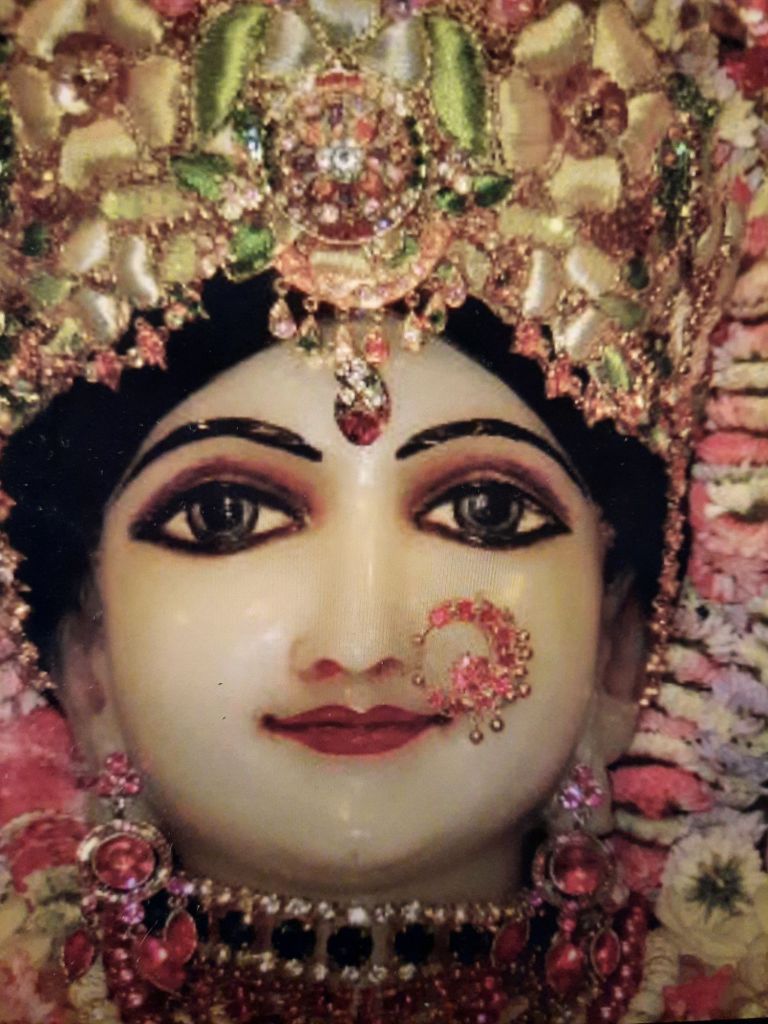
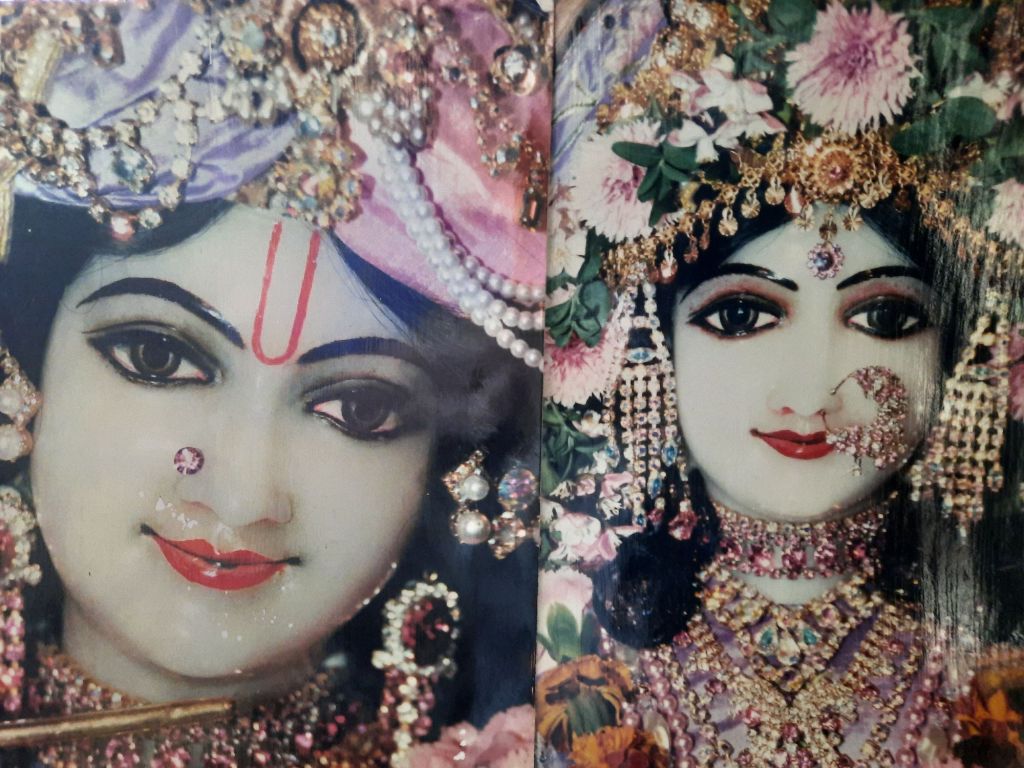
The Bhagavatam highlights the ultimate expansion of consciousness into spiritual forms that experience finer and finer emotions bringing ever increasing blissful experiences with Divinity Himself who is the master of loving exchanges, ,technically called rasa or mellows , a playground of consciousness and perfect form in its perfected state ,if you will ,under the direct supervision of agents who serve the emaculate spiritual senses of Divinity or Krishna who is accompanied by The personification of His own pleasure potency , representative of the female aspects of Divinity ,Namely Srimati Radharani who along with her confidants are imbued with ever blissful spiritual rasa .
The middle portion of the 10th canto of the Srimad Bhagavatam is said to be the smiling face of Krishna, those persons who have throughly studied the previous Cantos and who have understood Krishna as the supreme personality of Godhead along with His varigatedness energies, can eventually take to spontaneous loving service in a trancendental informal relationship based on pure love .
7.
It is a perfectly natural position for an individual to practice devotional service and have a personal relationship experiencing life to the full in relation to Krishna, who also possesses qualities as well as emotions ,which He is eager to exchange and share with others .
An impersonal path of merging in a spiritual light or the yoga astanga path of simply being a witness of Divinity within one’s heart is not as natural for individuals , actually its the personal position and not the impersonal position that we experience in our daily lives, hence the vedas say this life is a reflection of the spiritual realm . But in that spiritual realm, there is a full display of blissful varigatedness, a full display of blissful relationships, and a full display of beauty in every respect along with an unlimited display of trancendental artistry .
There are many benedictions offered by all the great teachers for those who have a set of Bhagavatams in their house for the ultimate well-being and protection for those who reside there , alongside this great literature which decends from the finest realms of consciousness . Indeed, the Bhagavatam is the book Bhagavat, and our leading acaryas are person Bhagavats, who are the personification of the Srimad Bhagavatams teachings , both purely represent Divinity.
The famous scholar of classical eastern Vedic philosophy Srila Jiva Goswami also divided the Bhagavatam into six parts .
I will publish tomorrow.
Here is an overview.
. Jīva Gosvāmī’s Sat Sandarbhas consist of six parts, each delving into a different aspect of the Bhāgavatam philosophy.
First is the Tattva Sandarbha, which has two divisions. In the first division, Śrī Jīva sets forth the epistemology of the personalist school. Here he tackles such questions as: What are the means of attaining knowledge? And, what is the evidence or proof in support of those means? In the second division , he explains the object to be realized by knowledge.
In the second book, Bhagavat Sandarbha, Jīva Gosvāmī speaks about the Divinity His abode, and His associates. He demonstrates with conclusive evidence that Divinity is the complete and indivisible Absolute Reality and that all other manifestations are dependent on and thus inferior to Him.
In Paramātma Sandarbha, Śrī Jīva tells of the three manifestations of Divinity and describes how the Immanent Being is related with each individual self in the material world. Śrī Jīva also describes illusion or the external potency of God.
In Kṛṣṇa Sandarbha, he shows that the form of Kṛṣṇa is the original form of Divinity and explains why He is the object of loving devotional exchanges. Then, in the Bhakti Sandarbha, Śrī Jīva establishes the path of devotion as the sole means to direct God realization. Finally, in Prīti Sandarbha, he analyses prema-bhakti, devotional service in pure love of God, and shows how it is the supreme goal of life for all living beings.