Category: Uncategorized
-
In one sense , according to the vedas we already have artificial intelligence, because if we cannot discriminate between matter and spirit ,or atoms ,molecules and elements , from the consciousness, we are already influenced by an artificial world or a virtual reality, it’s only when Krishna gives us spiritual intelligence that we can break free from an artificial intelligence , and see that consciousness particles are situated in machines made of matter .
How is this analysis given in more detail ?
That you will find in Bhagavad Gita as it is , A.C. Bhaktivedanta Swami is very expertly explaining with references to several parts of the Vedas .
-
The beginnings of Bhagavad Gita show the state of Dhrtarastra, he enquired about the state of play on the Kuruksetra battle field.
It appears that he is being conciliatory and would like to negotiate peace , but his internal thoughts were , if peace was to be negotiated, his sons would not have a free reign in the kingdom. He was confident of victory because he had the best of the warriors on his side , so ultimately he selfishly and ruthlessly pressed ahead in an attempt to go against Dharma and take what was not rightfully his families and suppress those who were the real heirs to a kingdom.
You can judge for yourself whether the USA and Europe have more rights in Ukraine than Russia, who have a long history with connections both in religion and culture.
Perhaps the might of the USA led coalition can be compared to Bhisma , appearing invincible, and the Ukrainian leaders are convinced the USA ways of operations are legitimate and represents purity and Dharma, others looking at the USA geopolitical manoeuvres may disagree.
Vedic culture is actually based on both unipolar and multipolar models. There is no call for globalists to be dominant , but rather a respect for differences be it autocratic government or so called democracy, which is proving to be a rather troubled system, with endless wrangling and unstable ever changing leaders , who have interests that appear to align with dubious persons and organisations, rather than the people, take a look at the free world and its current state.
One question which John Mearsheimer has asked…what would USA do if China were to have Mexico as its friend having spent billions of dollars influencing politics in Mexico, and the Chinese troops arriving on the USA borders with military hardware. Do we really think the USA would turn the other cheek . Surely Russia has legitimate concerns with a build up of military hardware on its borders and billions of dollars spent on influencing politics by the USA.. We hope good sense prevails and geopolitical academics, directed by sensibly minded persons can solve the problems, leaving the here today gone tomorrow, politicians to one side
-
In simple terms, if smoke is seen in a distant mountain, one can infer there is fire or if someone found a watch in the long grass in the eighteenth century, naturally a watch maker was assumed…( see William Paley )
Similarly, the simple arguments that the complexity of a single cell ,with hundreds of nano machines, each performing different functions implies a designer and the argument that wherever you find codes you know there must be a code maker , ie dna codes that produce protein machines that produce the individual bodies of all living beings, hold up in ancient nyaya logical systems of discussion , as such any teleological arguments certainly should be taken seriously.
In a discussion about truth , the qualifications for participation are that persons are sincerely looking for truth , if a discussion takes place where one or two of the participants are affected by a subjective biased opinion , its unlikely truth will be found .
The main qualifications in discussion are that persons are sincere searchers for truth , and can conduct discussion in logical ways ,….truth actually is self evident to the sincere seeker it is said , and after careful debate with honest persons ,truth will out.
Sukadevathevedicspectator@gmail.com
-
What is an observer? Physicists puzzle over this question, as Richard Feynman once famously said, if you think you understand quantum physics ,then you know nothing of it .
But the Vedas state plainly an observer is consciousness either directly or indirectly, the Vedas further state this consciousness is eternally individual and has eternal desire. Currently, consciousness is placed within laws of nature that differ from the consciousness, so that’s a problem , how to place consciousness that has eternal desires in a fixed state , where desires can be fulfilled without interpretations such as birth ,death, old age and decease and placed in energies and laws that do not hamper the consciousness .
Thus, consciousness can be surrounded by the same energy it is fundamentally made from . That is the offer being made by the Vedas and, in one sense, all bone fide religious teaching and our best use of our God given intelligence is to seek out solutions to the most extreme difficulties we face , old age ,decease and death .
The technical term in the Vedas is apavarga and parvarga means bondage. Pa.pha.ba.bha.ma.
Pa .very hard labour.
Pha. Foam at mouth
Ba. dissapointment
Bha. Fear
Ma. Death .
The reality and truthful, accurate way of analysing our current predicament.
Sukadevathevedicspectator@gmail.com
-
Why should I have any interest in an ancient scripture called the Srimad Bhagavatam?? What does it contain anyway?? What is in it for me or society as a whole? Does such ancient literature have any relevance in today’s technological world with fast communication and instant pleasures for the body, and, as it is claimed, where economic development is liberating many from poverty and bringing far better standards of life??
These are the questions many people pose when approached by those who study the science of self-realization contained within the Bhagavatam, a science of the study of consciousness within the confines of matter, consciousness that finds itself within spacetime dimensions , as depicted by Einstein, and consciousness along with the body is under mother natures strict physical laws that everyone is forced to submit to.
The progressive spiritual seeker appreciates that the contents of the Bhagavatam do not contradict objective, empirical science. Today, multidimensional spacetime is readily accepted by modern physicists, the Harvard PROFFESOR Lisa Randall teaches openly such mathematical observations , biologists see significations of design and mathematical symmetry in the organic world they study, and leading chemists are often aware that the theory that consciousness is an upshot of a combination of material elements is no less than derisory; an ultimately lame attempt by the Darwinian to explain subjective existence as a phenomenon of mechanistic science.
The substrata of the material universe is fundamentally atomic; so says the Srimad Bhagavatam. Coincidentally, Niels Bohr, who helped define the Copenhagen interpretation of quantum physics, also studied the Vedas closely. The Bhagavatam describes material nature as a quantum reality with endless possibilities, a reality which responds to the free will and determinism of each individual within it. It also elaborates on multidimensional spacetime, and introduces the concept of three overarching principles, or modes, of material nature. As an example of the kind of quandary scientific discoveries sometimes present, whilst modern physicists believe changes in gravity can determine how nature operates, they are puzzled that gravity on earth is a relatively weak force. The Bhagavatam’s resolution for the puzzled (in keeping with Kantian logic that senses do not perceive all levels of existence) is acceptance of the ethereal plane, the as yet undetected plane of existence which modulates, and so defines, current laws of quantum and classical physics.
What is the origin of the Srimad Bhagavatam?
The Srimad Bhagavatam is a natural commentary on, and also, a companion to, the Vedanta Sutras. ‘Veda’ means ‘knowledge’, and ‘anta’ means ‘ultimate’. The Veda-anta comprises Sutras which are condensed forms of information, sort of codes or dense stanzas that can be greatly expanded upon. The Vedanta sutra itself is a distillation of the knowledge of the original four Vedas written by the Indian sage Vyasadeva. These voluminous original four Vedas give directions to mankind to develop and progress in every conceivable way, but at the same time, they underline the main purpose of human life as love of God.
All living beings already have a connection with God. Inspiration, for example, is a phenomenon that clearly exists. Researchers, philosophers and scientists often comment that ‘eureka’ moments confront them at the unlikeliest of moments, shopping in the tinned veg isle, or perhaps feeding the budgerygar. The physicist Richard Feynman has commented that an intense focus of attention to a sticky problem predictably leads to an extraordinary emergeance of solutions. Similar experiences are shared by many in all manner of creative and artistic fields.
The achievements of writers and philosophers from time out of mind should not be overlooked, but rather judged by their merits. Vyasadeva compiled the Vedas many thousands of years ago, but these are inspired works by any estimation. As an incarnation of God himself, as the source of all inspiration, one discovers on inspection, he has some very pertinent things to say about the purpose of life. An interesting thought regarding perennial questions of mankind such as “What is consciousness?” and “How do we understand the world that surrounds us?” is, where on earth these questions come from?
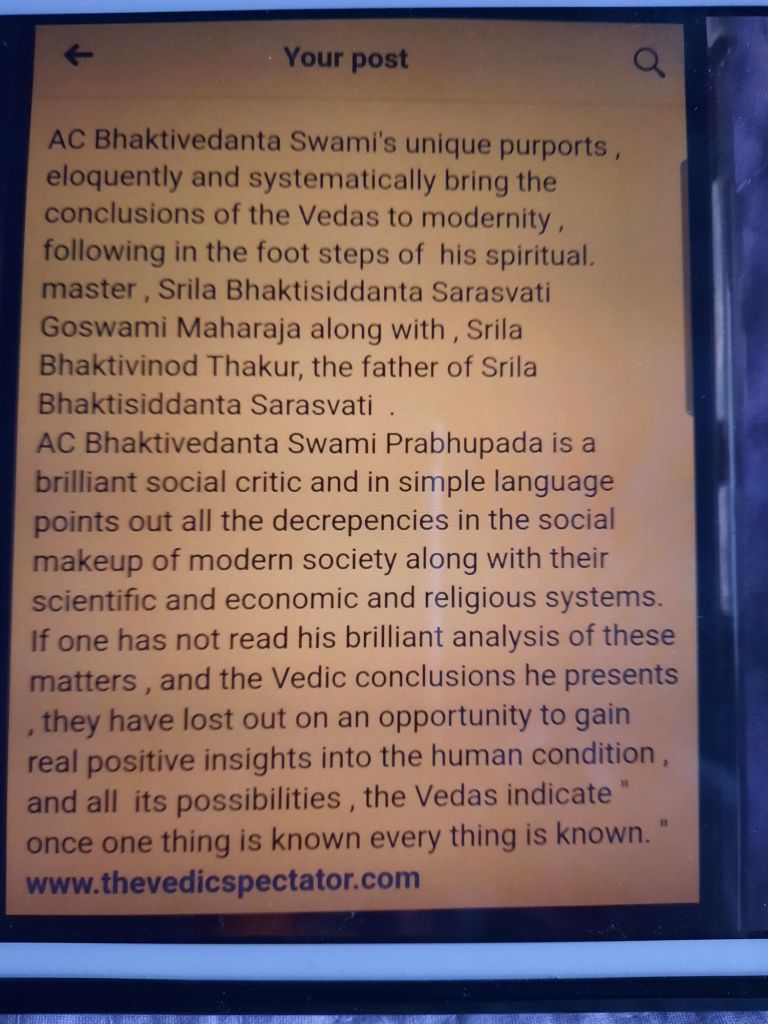
The Srimad Bhagavatam presented to you by the scholar and devotional practitioner A.C. Bhaktivedanta Swami Prabhupada is a commentary on the original four Vedas along with their summary, the Vedanta Sutra. It incorporates the teachings of four original professors of spiritual knowledge, namely Lord Brahma, Sri Laksmidevi, the Kumara sages, and the enigmatic Lord Shiva. These professors established lineages, known as ‘sampradayas’, that protect and pass down the Vedic knowledge from one generation to another. Scholars that have risen to prominence in these four ‘sampradayas’ over the last couple of millenniums have been Madhvacarya, Ramanujacarya, Nimbarkacarya and Vallabhacarya. Their teachings are incorporated into AC Bhaktivedanta Swami Prabhupada’s purports on the Srimad Bhagavatam texts. Prabhupada was himself taught by his own teacher, or spiritual master, Srila Bhaktisiddanta Sarasvati Goswami , who was the son of Srila Bhaktivinod ThakurBhaktisiddanta Sarasvati Goswami was a disciple of Srila Gour Kisor das babaji .
Historically, and according to time and circumstance, the above historical scholars of the Indian sub-continent presented the full picture of the Absolute Truth incrementally. The full picture of the individual living being and God is that they are inconceivably one and different from one another. A familiarity with the emphasis that each of the eminent scholars brings to the fore informs us of this bigger picture. An appreciation of the ‘advaita-vada’, or ‘oneness’, of one scholar, should be balanced with a good appreciation of the ‘dvaita-vada’ or ‘difference’ from God, of the other.
A.C. Bhaktivedanta Swami is a follower of the teachings of Sri Caitanya Mahaprabhu, who is the chief, and most recent exponent of the Truth of inconceivable oneness and difference, and also an incarnation of the Supreme Personality of Godhead, Sri Krishna. Sri Chaitanya Mahaprabhu entrusted His teachings to His direct disciples Sanatana Goswami, Rupa Goswami, Jiva Goswami and Raghunatha das Goswami, who in turn established His teachings on a sound scriptural and philosophical basis. Today, the erudition of these Goswamis is greatly respected in universities throughout the world.
Sri Caitanya Mahaprabhu’s ultimate teachings is that all living beings have an eternal relationship with the Supreme Personality of Godhead, Sri Krishna, in one of five ‘rasas’ or varieties of loving mellows, from neutrality through to divine conjugal love. These relationships are described in the Vedas as confidential, more confidential and most confidential.
A.C. Bhaktivedanta Swami explains in his introduction to the Bhagavatam that the broad conception of ‘God’ is not on the same level as a realisation of the Absolute Truth. The Srimad Bhagavatam brings into focus the Absolute Truth, that is, the Supreme Personality of Godhead Sri Krishna, who Himself possesses innumerable energies which are manifested in perfect design and perfect order. He is the cause of all causes, who acts to facilitate the free will of the individual being in this world, but who also fashions nature in such way as to guide and correct living entities so that they are restored to their constitutional position of spontaneous love for Him.
The principles of the Bhagavatam can be applied in all fields; political, social, economic, judicial, military etc., and they’re principles that can raise the merit of any value system. There is much that can be gleaned here for the spiritual upliftment of all living beings, and the spiritual perfection of love for Krishna encompasses love for every living thing, since all living things are eternally parts and parcels of Him. The symptoms of someone completely on the spiritual platform is the absence of all anxieties, and a satisfaction and bliss wherein there is no concern for material loss, and no hankering for material, temporary gain whatsoever. This state is termed the “param gatim”, the supreme goal of life superseding all other goals, and quite naturally the goal which should always be born in mind.
Sukadevathevedicspectator@gmail.com
Sent from my iPad
-
Let’s create a society based on just political systems with accountability and not hypocrisy
The four ‘Vedas’, namely Rig-Veda, Atharva-Veda, Yajur-Veda and Sama-Veda contain the complete knowledge of Krishna in all His aspects , namely His personality and His separated enegies including his individual parts and parcels and the Maha Tattva ie.‘Physical universe’. Rig-Veda explains the ‘cosmic order’ stating that physical as well as moral laws govern the entire universe and that transgression of these laws should be prohibited Vedic philosophy derives infinite creativity, actions and power from universal laws of Nature, or ones God given talent should be correctly adopted in the service of Divinity. Twentieth century has witnessed increasing focus on growth and accumulation of wealth at the cost of society resulting in many socio-economic, political and environmental problems. It has led to mass exploration of everyone and everything . In Vedic philosophy, core function of business is to create wealth for society based on ‘Sarva Loka Hitam’ which means “Well being of all stakeholders”. Krishna indicates in ‘Bhagavad Gita’ leaders should be ‘wisdom workers’ who focus on Education, Values, Principles and Wisdom leading to spiritual consciousness in service to Divinity. Sustainable growth comes by earning money following ‘Values’. Key to success lies in ‘Yajna’, sacrifice ultimately to Divinity through his bone fide representatives . The long-term interest of any society are best served by adopting an integrated approach . In essence, Vedic way for sustainable growth ensures continuous flow of knowledge, finances, physical resources, learning and information like a river for the prosperity of ‘Global Society’ – but each administrated locally with out global exploration of a few dominating and shaping everyone’s future .Thesis .antithesis, synthesis. The perfection of understanding , Krishna says one who sees Me everywhere and everything in Me is never lost to Me
One essential project of Prabhupada was the Bhaktivedanta Institute, this body examines in a scientific way all aspects of the Vedas and along with the intelligent design movement explaining to the public objectively how the material world functions, the five topics of Bhagavad Gita are Divinity, the individual entity, nature , space time and karma , Or synchronicity effects on an individual human being within the laws of free will and determinism.We want to hold scientific conferences bringing further understanding of the Vedas , Niels Bohr one of the great thinkers in the feild of quantum physics studied the vedas ,and his Copenhagen interpretation of consciousness and its effect on matter parallels the Vedic conclusions .
Sukadevathevedicspectator@gmail.com